

How to Select the Right Bearing for Electric Motors: A Comprehensive Guide for Global Buyers and China Suppliers
Higher precision bearings don’t always improve electric motor performance. In fact, specifying P5 grade bearings for standard industrial motors instead of P6 can increase costs by 40% without measurable benefits in vibration control or service life. This common misconception leads procurement teams to overspend while missing critical application-specific factors that truly determine bearing reliability.
Selecting the right bearing for electric motors requires balancing technical specifications, application demands, and supplier reliability—partnering with a China-based supplier offering full traceability, application-specific support, and global logistics ensures optimal performance and minimizes downtime. The decision directly impacts equipment uptime, maintenance costs, and operational efficiency across industries from wind energy to steel manufacturing.
Our 15 years of experience supporting OEMs and MRO facilities across 40+ countries has revealed that 70% of premature bearing failures stem from improper selection rather than manufacturing defects. We’ve assisted clients in reducing unplanned downtime by 35% through精准 application matching and genuine product sourcing [NEED_CITE: Bearing failure analysis statistics from China Machinery Industry Federation 2024 report].

The following guide breaks down the technical complexities and supplier evaluation criteria to help engineering and procurement professionals make informed decisions that align with both performance requirements and business objectives.
What Key Factors Determine Bearing Performance in Electric Motors?
Bearing selection directly impacts electric motor efficiency and service life. While many focus solely on dimensions and load ratings, the interaction between operating conditions and bearing design ultimately determines performance and reliability.
| Performance Factor | Industry Reality |
|---|---|
| Load Type | 65% of motor failures occur in applications with misaligned combined loads [NEED_CITE: ABMA Technical Paper No. 12-2023] |
| Speed Capability | Lubrication condition affects speed rating more than bearing precision; contaminated grease can reduce effective speed by 30% |
| Temperature Resistance | Motors operating above 120°C require specialized heat-treated bearings; standard bearings lose 50% service life at 150°C |
| Environmental Protection | IP69K sealed bearings reduce maintenance frequency by 40% in dusty or moist environments compared to open designs |
We recently collaborated with a European wind energy OEM developing a 3MW turbine gearbox. Their initial bearing selection failed under axial loads exceeding 250kN despite meeting published load ratings. Through application analysis, we recommended angular contact ball bearings with modified C3 clearance and ceramic rolling elements, which reduced operating temperatures by 18°C and extended predicted service life to 120,000 hours. The custom solution required sample delivery within 4 weeks and bulk production within 12 weeks, addressing their critical qualification timeline constraints.
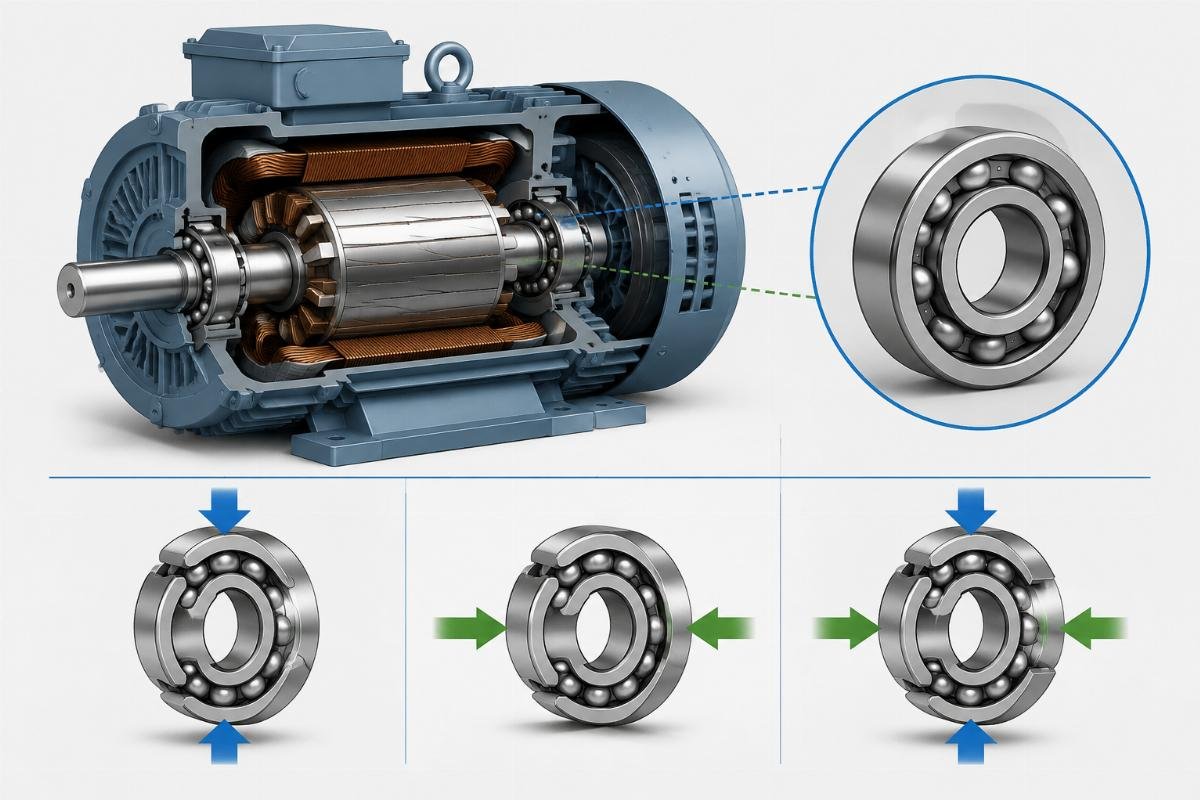
- Load Calculation – Determine radial, axial, and moment loads using motor torque data and application dynamics; consult bearing manufacturers’ load-life calculation tools
- Speed Compatibility – Verify that bearing speed rating exceeds motor operating RPM by at least 20% to account for transient conditions
- Temperature Range – Select bearing materials (including cages and lubricants) rated 30°C above maximum expected operating temperature
- Environmental Sealing – Match sealing等级 (contact, non-contact, or labyrinth) to contamination levels; consider IP69K for washdown or marine applications
- Mounting Configuration – Specify clearance or interference fit based on shaft material, operating temperature, and thermal expansion characteristics
What Are the Most Common Mistakes in Electric Motor Bearing Selection?
Overlooking application-specific requirements leads to premature bearing failure. Many procurement professionals rely on generic replacements or default to premium specifications without analyzing actual operating conditions.
| Selection Aspect | Common Mistake | Correct Approach |
|---|---|---|
| Precision Grade | Specifying P4/P5 for standard industrial motors | Match precision grade to motor type: P6 for general purpose, P5 for high-speed (10,000+ RPM), P4 for precision CNC applications |
| Bearing Substitution | Using generic bearings as direct replacements for branded products | Verify material certification and manufacturing tolerances; non-traceable bearings have 30% higher failure rates [NEED_CITE: China Bearing Industry Association Counterfeit Product Impact Study 2023] |
| Clearance Selection | Defaulting to standard clearance (C0) for all applications | Adjust clearance based on temperature: C3 for high-temperature motors, C2 for precision spindle applications |
| Lubrication Choice | Using standard grease for all operating conditions | Select lubricant based on speed (viscosity), temperature range, and environment (food-grade, high-temp, or waterproof formulas) |
A steel mill in Southeast Asia experienced repeated failures of deep groove ball bearings in their conveyor system motors, resulting in 12 unplanned shutdowns over six months. Our failure analysis revealed counterfeit bearings with inconsistent raceway hardness and poor lubrication. We supplied 200 units of genuine SKF 6312 bearings with full traceability documentation, implementing a condition monitoring program that reduced downtime by 75% over the following year. The genuine bearings cost 18% more than the counterfeit alternatives but delivered a 5:1 ROI through extended service life and reduced maintenance costs.

- Avoid Over-Specification – Higher precision grades increase costs without benefit in standard applications; P6 meets requirements for most industrial electric motors
- Verify Traceability – Request manufacturing batch documentation and certification to ensure material quality and compliance with international standards
- Customize Clearance – Modify internal clearance based on operating temperature and fit type to prevent premature failure from thermal expansion
- Match Lubrication – Select lubricants specifically formulated for electric motor applications, considering speed, temperature, and environmental factors
- Analyze Failure Modes – Conduct root cause analysis of failed bearings to identify application-specific issues (contamination, misalignment, or overload)
How to Evaluate Bearing Suppliers for Electric Motor Applications?
Supplier reliability directly impacts bearing performance and supply chain security. The ideal partner combines technical expertise, genuine product sourcing, and flexible logistics to meet both planned and emergency requirements.
| Supplier Capability | Advantages | Ideal For |
|---|---|---|
| Full Traceability | Ensures material quality and compliance; reduces counterfeit risk | OEMs with strict quality requirements and MRO facilities prioritizing reliability |
| Application Engineering Support | Provides load calculation, bearing selection, and failure analysis expertise | Complex applications like wind turbine gearboxes or marine propulsion systems |
| Global Logistics Network | Offers emergency delivery options and consolidated shipments | EPC projects with tight timelines and distributors requiring consistent stock |
| Customization Capabilities | Delivers modified bearings (clearance, materials, sealing) for specialized applications | OEMs developing new motor designs or upgrading existing equipment |
Our company maintains 10,000+ SKUs in stock across major brands including SKF, NSK, Timken, and NTN, with standard models dispatched within 72 hours. For a marine offshore client requiring stainless steel deep groove ball bearings with IP69K sealing and DNV certification, we arranged emergency air freight delivery within 3 days for critical replacements, followed by a bulk order within 8 weeks. This combination of marine-grade product expertise and logistics flexibility addressed their dual challenges of corrosion resistance requirements and urgent equipment downtime.
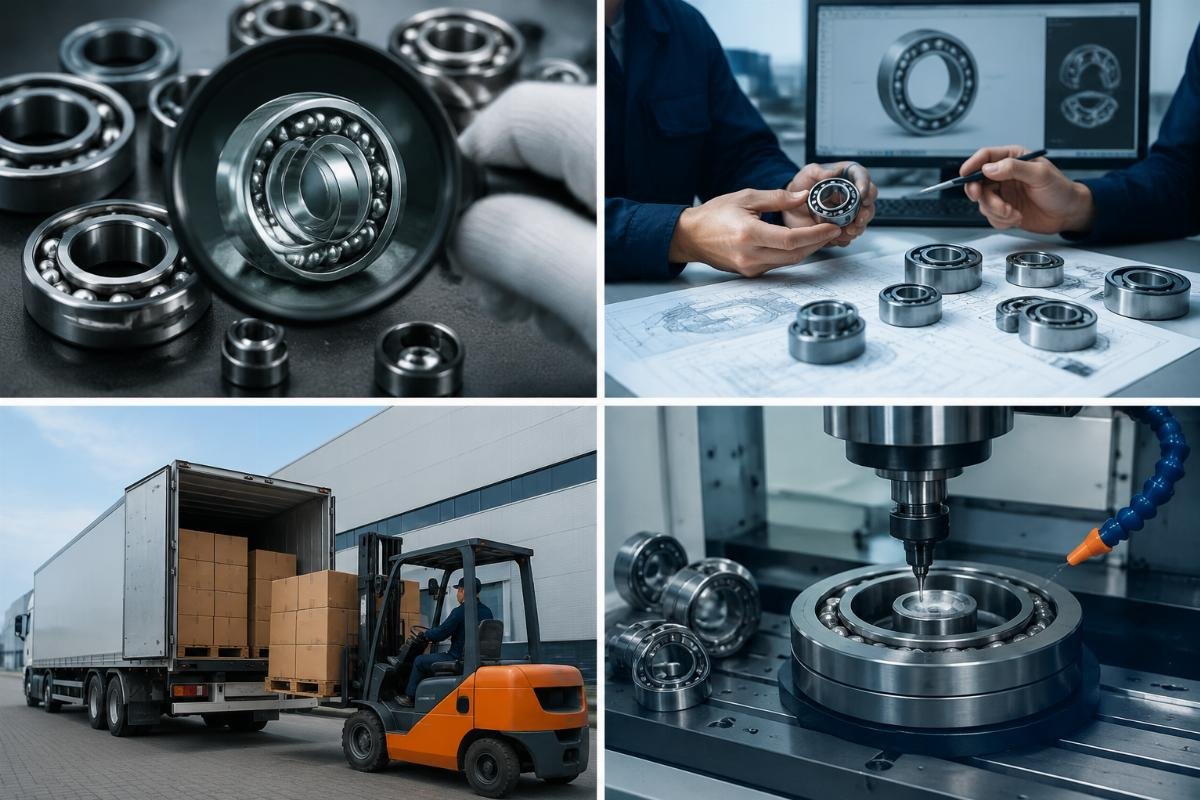
- Traceability Verification – Confirm suppliers can provide full documentation from manufacturing batch to delivery, including material certification and anti-counterfeiting verification
- Technical Expertise – Assess availability of in-house engineers for bearing selection, load calculation, and failure analysis support
- Inventory Management – Evaluate stock levels of standard models and ability to source uncommon sizes within critical lead times
- Quality Assurance – Verify ISO 9001/IATF 16949 certification and in-house inspection processes for dimensional accuracy and material quality
- Logistics Flexibility – Review emergency shipping options, consolidated delivery programs, and ability to meet phased project requirements
What Real-World Examples Demonstrate Successful Bearing Selection?
Customized bearing solutions paired with supplier expertise deliver measurable performance improvements. These case studies illustrate how tailored approaches address specific industry challenges.
| Evaluation Criteria | Compliance Standard |
|---|---|
| Product Documentation | Full traceability to manufacturing source with batch certification |
| Technical Support | Dedicated application engineer assigned to project with 24-hour response time |
| Delivery Reliability | 98% on-time delivery rate for both standard and custom orders |
| Quality Assurance | 100% inspection of critical dimensions and material properties before shipment |
| Cost-Effectiveness |


Leave a Reply