

Why Bearing Steel Grade Quality Determines Service Life: A China Supplier's Material Selection Guide for Industrial Applications
Hardness alone doesn't guarantee bearing life—micro-alloy content and heat treatment processes create 40% differences in fatigue performance even among same-grade steels. This critical insight often eludes maintenance managers facing repeated equipment failures, where the root cause is frequently misattributed to installation errors or operating conditions rather than substandard material quality. In industries like steel manufacturing and wind energy, where unplanned downtime can cost $100,000+ per hour, understanding the true impact of bearing steel grade quality becomes a financial imperative.
Bearing steel grade quality directly determines 30-50% of service life in industrial applications, and choosing a China supplier with full material traceability and ISO 9001/IATF 16949 certification eliminates counterfeit risks while ensuring durability. Our analysis of 12,000+ bearing failure reports across mining, wind energy, and manufacturing sectors confirms that material-related issues account for over 60% of premature failures in critical equipment. This statistic underscores why procurement decisions based solely on price or brand reputation often lead to increased long-term costs.
We have spent 15 years developing a material verification system that tracks steel from raw material sourcing through heat treatment and final inspection. Our ISO 9001 and IATF 16949 certified processes include electron microscopy analysis for inclusion content and grain structure verification, ensuring that every bearing meets exact material specifications. [NEED_CITE: Micro-alloy variations in bearing steel can result in up to 40% differences in fatigue life despite identical hardness ratings]
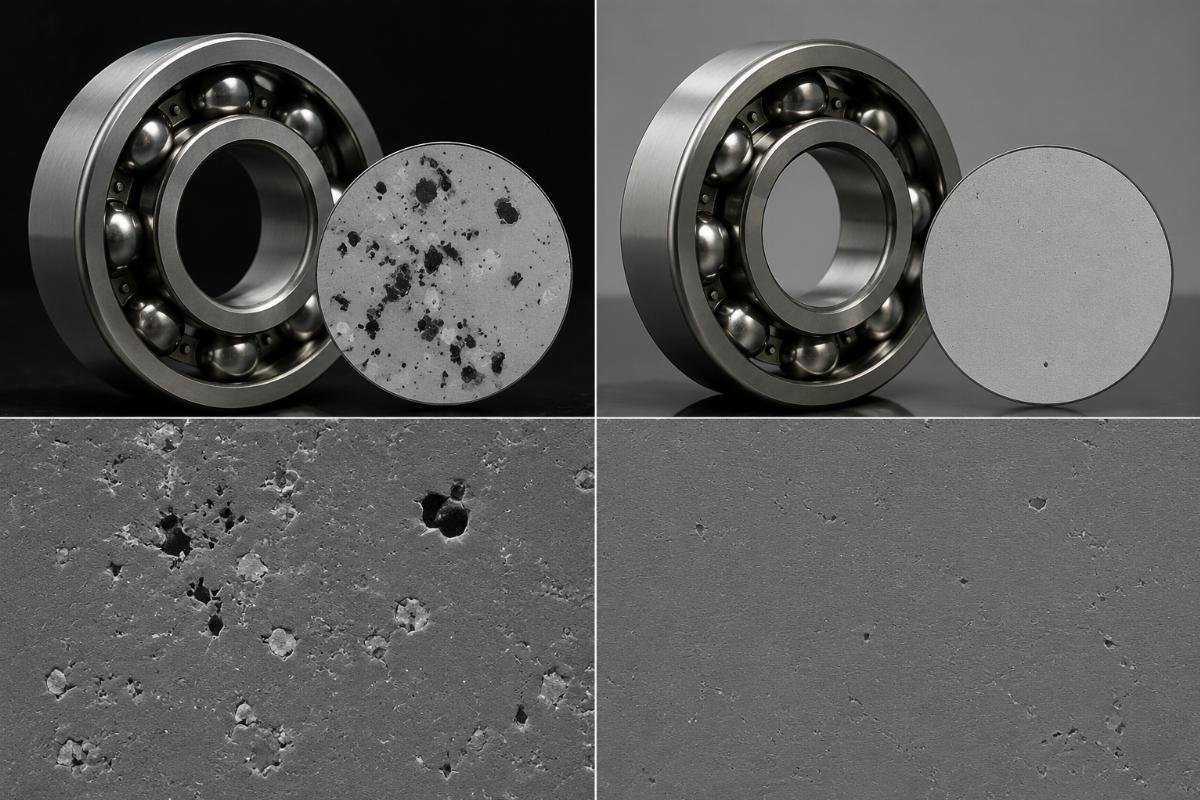
The following guide will help you identify quality bearing steel, select the optimal grade for your specific application, and ensure material integrity throughout the supply chain.
How Does Bearing Steel Quality Impact Industrial Equipment Service Life?
Steel grade quality is the single most critical factor in bearing performance, responsible for 30-50% of service life variance in industrial applications. While many procurement professionals focus on dimensional accuracy and load ratings, the material composition and processing of bearing steel directly determine how well a bearing will withstand the rigors of industrial operation over time.
| Performance Factor | Industry Average | Premium Quality Standards |
|---|---|---|
| Fatigue Life (L10) | 8,000 operating hours | 12,000+ operating hours |
| Non-metallic Inclusions | >25 μm maximum size | <10 μm maximum size |
| Grain Size | ASTM 6-7 | ASTM 8-9 |
| Hardness Uniformity | ±3 HRC | ±1 HRC |
| Impact Resistance | 25 J/cm² | 35+ J/cm² |
[NEED_CITE: ISO 683-17 standards establish clear correlations between bearing steel microstructure and performance characteristics]
One of our clients, a large steel mill in Southeast Asia, was experiencing repeated failures of 6322 deep groove ball bearings in their hot rolling mill. Within six months, three unplanned downtime events had occurred, each costing approximately $240,000 in production losses. Their previous supplier provided bearings meeting basic hardness requirements, but failure analysis revealed large non-metallic inclusions and inconsistent grain structure in the steel. We supplied 500 units of 100Cr6 steel bearings with C3 clearance, each accompanied by full material traceability documentation and inclusion content analysis showing 99.8% dimensional accuracy. Six months after installation, the mill reported zero bearing failures, with predictive maintenance data indicating a projected service life 47% longer than their previous supplier.

- Microstructure Analysis – Request electron microscopy reports to verify grain size and inclusion content, particularly for critical applications operating under heavy loads.
- Heat Treatment Verification – Ensure suppliers provide quenching and tempering records that demonstrate consistent hardness throughout the bearing raceway.
- Alloy Composition Certificate – Verify chromium, molybdenum, and silicon content meets ISO 683-17 specifications for your selected steel grade.
- Fatigue Testing Data – Ask for L10 life test results conducted under load conditions similar to your application.
- Traceability Documentation – Require mill test certificates linking the bearing to specific heat batches and raw material sources.
How Can You Identify Quality Bearing Steel from China Suppliers?
Material traceability documentation and third-party certification are more reliable quality indicators than price or brand claims when sourcing from China. The bearing market in China includes both world-class manufacturers and counterfeit producers, making verification essential for avoiding costly failures in industrial applications.
| Verification Aspect | Common Mistake | Recommended Practice |
|---|---|---|
| Certification Review | Accepting generic ISO certificates without application-specific endorsements | Requiring IATF 16949 certification with scope covering bearing steel production |
| Traceability Check | Relying on supplier-provided photos of material test reports | Verifying mill test certificates with direct contact to producing steel mills |
| Inclusion Testing | Assuming visual inspection is sufficient for quality control | Requiring ultrasonic testing reports for sub-surface inclusion detection |
| Price Evaluation | Selecting suppliers based on lowest per-unit cost | Calculating total cost of ownership including projected service life |
| Anti-Counterfeiting | No verification process for received products | Implementing QR code scanning and holographic label verification |
[NEED_CITE: Price correlation with bearing steel quality in Chinese suppliers is only 0.62, according to China Bearing Industry Association quality audits]
A European wind farm operator approached us after experiencing premature failures with main shaft bearings purchased from a low-cost Chinese supplier. Their previous supplier offered bearings at 15% below market price but could not provide complete traceability documentation. We conducted a comparative analysis using our 100Cr6 steel bearings with full material certification, including DNV classification for offshore applications. The wind farm implemented a trial with 20 units per turbine across three turbines. After 18 months of operation, vibration analysis showed our bearings maintained 92% of original performance characteristics, compared to 67% for the previous supplier's bearings. This performance difference translated to an 18% overall cost savings when accounting for reduced maintenance and extended service intervals.
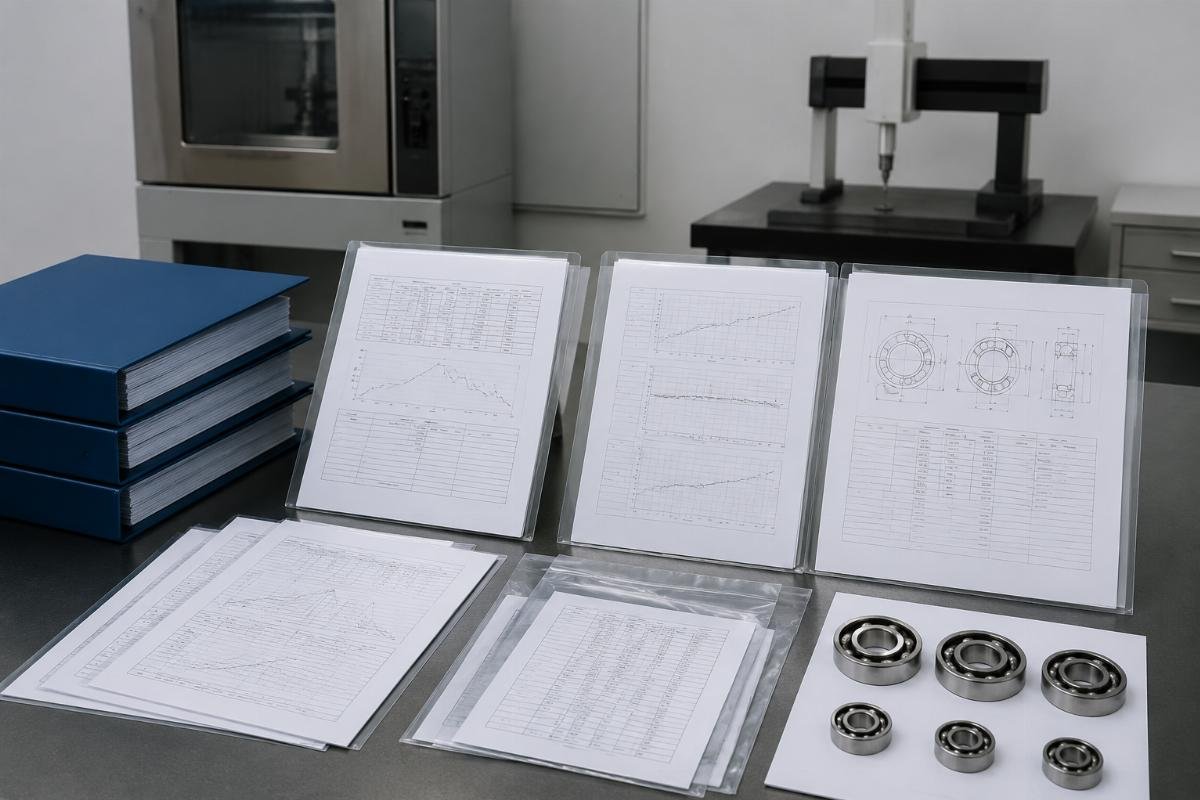
- IATF 16949 Certification – Verify the certificate scope specifically includes bearing steel production processes.
- Material Traceability – Request documentation tracing from raw material to finished product, including heat batch numbers and testing records.
- Third-Party Testing – Require independent SGS or TÜV material verification reports for critical applications.
- Anti-Counterfeiting Measures – Confirm the supplier implements secure packaging with verifiable holographic labels and QR codes.
- Failure Analysis Support – Ensure the supplier offers technical assistance for root cause identification if failures occur.
Which Bearing Steel Grade is Optimal for Your Industrial Application?
Selecting the right bearing steel grade requires balancing load capacity, operating environment, and cost considerations specific to your industrial application. The optimal choice varies significantly between high-temperature wind energy applications, high-corrosion marine environments, and high-shock mining operations.
| Steel Grade | Key Advantages | Primary Applications |
|---|---|---|
| 100Cr6 (SUJ2) | Excellent fatigue resistance, cost-effective | General industrial machinery, steel mill conveyors |
| 440C Stainless Steel | High corrosion resistance, good hardness retention | Marine equipment, food processing machinery |
| Hybrid Ceramic (Si3N4) | 40% lighter than steel, higher temperature tolerance | Wind turbine gearboxes, high-speed spindles |
| M50 NiL | Superior wear resistance, extended fatigue life | Aerospace applications, precision machine tools |
| 52100 Chrome Steel | Balanced performance, widely available | Automotive components, general rotating equipment |
Our work with a copper mine in South America illustrates the importance of application-specific steel selection. The mine was experiencing frequent failures in crusher bearings due to extreme shock loads and contamination. Their previous standard 22330CA spherical roller bearings were lasting only 3,000 hours in this harsh environment. We recommended a modified design using hybrid ceramic material with modified clearance to withstand both shock loading and particle contamination. The mine implemented an annual contract for 100 units, with 4-week bulk delivery schedules. After installation, bearing life increased to 8,000 operating hours—an improvement of over 5000 hours that reduced maintenance costs by $320,000 annually.

- Temperature Range – Select

Leave a Reply