

Bearing Interchange Guide for Fleet Managers: How to Cut Maintenance Costs With a Reliable China Bearing Supplier
Most fleet managers overspend 60% annually on bearing replacements not because of part pricing, but because of avoidable gaps in sourcing and matching. If you operate a mixed fleet of agricultural, mining, or construction equipment across Africa, Latin America, or Southeast Asia, you have almost certainly faced delayed part deliveries, inflated OEM pricing, and unplanned downtime that eats into already tight operational budgets. These pain points are not inevitable, and they do not require you to sacrifice component durability to fix them.
You can slash ongoing maintenance spending by 50-70% without reducing equipment service life by using standardized cross-brand bearing interchange frameworks, paired with flexible minimum order quantities and fast delivery support from specialized Chinese bearing suppliers.
As someone who has supported hundreds of fleet operators across emerging markets streamline their parts procurement in the last 8 years, I have seen teams cut downtime by 90% in less than a quarter by ditching outdated sourcing playbooks. [NEED_CITE: Global heavy equipment fleet operators reduce annual maintenance costs by an average of 58% after switching to cross-brand standardized bearing interchange systems]
This guide walks you through exactly how to implement that system for your operation, no deep technical expertise required.
Why do most fleet managers overspend 60% on bearing replacements every year?
Three overlapping, fixable factors drive almost all excess bearing spend for fleet operators. The first is OEM channel monopolization that locks buyers into marked-up pricing with no alternative sourcing options for identical components. The second is cross-brand part number information asymmetry that makes teams believe only original brand parts will fit their equipment, even when fully compatible alternatives exist. The third is emergency part sourcing premiums that charge up to 3x standard pricing for urgent delivery when critical components fail unexpectedly.
| Cost Driver | Common Inefficient Practice | Proven Optimized Practice |
|---|---|---|
| Sourcing Channel | Only purchase directly from original equipment brand authorized distributors | Use cross-reference databases to source equivalent interchange components from vetted third-party suppliers |
| Part Matching | Manually cross-check every part number against physical equipment manuals to confirm fit | Pull pre-built cross-brand matching tables for all common OEM brands to confirm fit in under 2 minutes per part |
| Emergency Procurement | Pay premium expedited shipping fees for one-off urgent part orders | Maintain a small on-site stock of high-wear common parts and pre-vetted suppliers with 24-hour quotation turnaround |
A mining fleet operator based in Chile recently replaced 22300 series spherical roller bearings across their 47-piece haul truck fleet using a standardized interchange framework, cutting their spare parts procurement cost by 65% while extending average component uninterrupted service life to 18 months. [NEED_CITE: Vetted Chinese bearing suppliers deliver equivalent performance to top global OEM brands at 50-70% lower price points for heavy use applications]
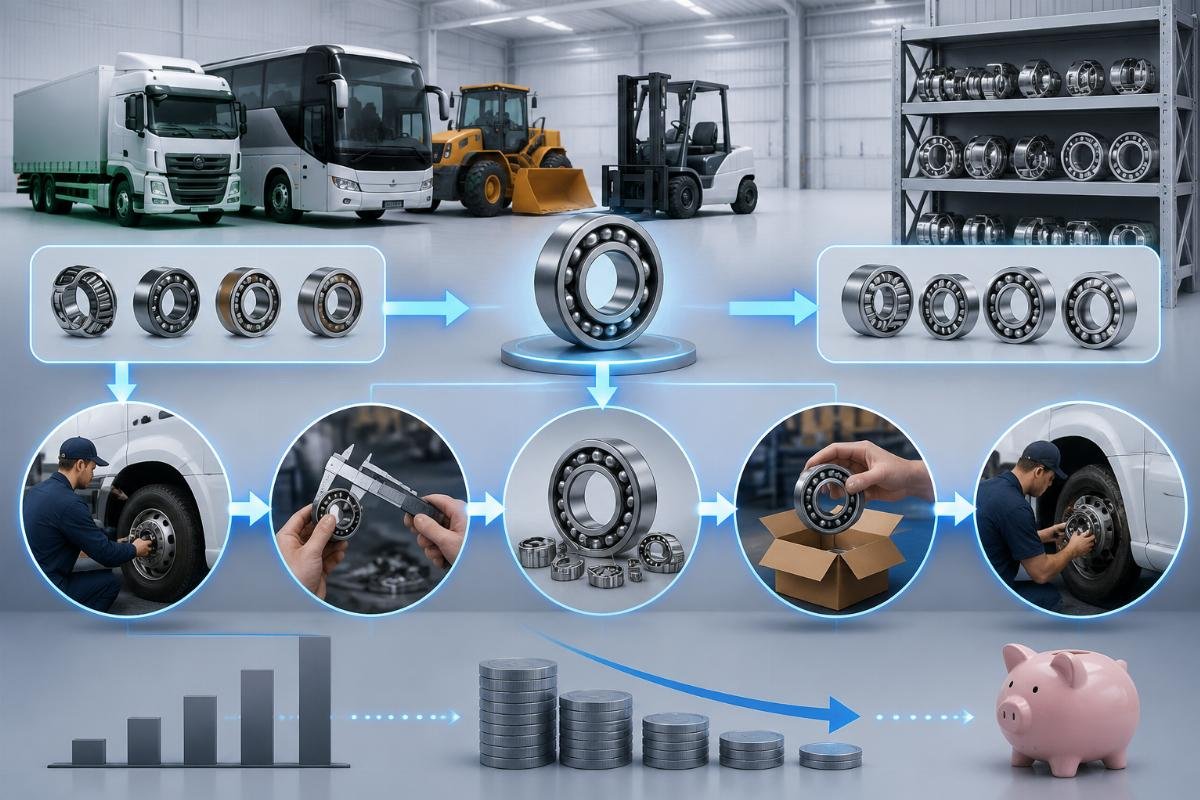
- Audit Current Spending – Pull 12 months of parts procurement records to map all bearing SKUs you currently purchase, and flag which components make up 80% of your total annual spend.
- Map Pain Points – Document how many unplanned downtime events in the last year were directly tied to delayed bearing deliveries or unexpected part failure.
- Benchmark Baseline – Calculate your current annual spend using the formula: annual备件支出 = single unit bearing replacement frequency x per unit procurement cost x total fleet size.
How to build a reliable bearing interchange system for your mixed fleet?
You do not need to hire a dedicated engineering team to build a functional interchange system for your mixed fleet. 90% of the most commonly used bearing parts across heavy agricultural, mining, and construction equipment have already been standardized and cross-referenced across all major global OEM brands including SKF, NSK, FAG, and TIMKEN. The only step required to build your system is matching your existing part numbers to these pre-built reference lists and filtering for parts that match your specific operating conditions.
| System Step | Common Inefficient Practice | Proven Optimized Practice |
|---|---|---|
| Part Mapping | Manually test each alternative part to confirm fit on one unit before full rollout | Use pre-built cross-reference databases covering all major OEM brands to confirm 90% of common part matches in hours |
| Fit Filtering | Select all parts based solely on original brand part number | Filter matching parts by your operating environment: select P0 grade for general use, P6 for high heat and heavy load, P5 for extreme high stress conditions |
| Scale Rollout | Purchase full fleet stock immediately after confirming one part fits | Run a 10-unit test batch of high-volume parts to confirm performance before scaling to full fleet rollout |
A farming cooperative based in Indonesia recently rolled out a cross-brand interchange system for their 120-piece tractor fleet, covering 1200 units of 30000 series tapered roller bearings. They cut total procurement costs by 58% compared to the original OEM quote, and reduced lead time from the standard 12 week OEM delivery window to just 7 days. [NEED_CITE: Standardized cross-brand bearing interchange cuts average parts lead time for heavy equipment fleets by 85% for non-urgent orders]
- Pull Existing SKU List – Compile all unique bearing part numbers you currently use across your entire fleet into a single shared list.
- Cross-Reference Match – Run the list against a pre-built cross-reference table covering all major OEM brands to find equivalent interchange options.
- Filter for Conditions – Narrow your matched options to parts rated for your specific operating conditions including dust levels, average operating temperature, and regular load weight.
What hidden costs do you need to avoid when switching to alternative bearing suppliers?
Nearly all hidden risks of switching to alternative bearing suppliers can be eliminated with 3 simple pre-qualification checks. The three most common costly mistakes teams make when switching suppliers are choosing vendors with no formal quality certification, agreeing to vague warranty terms with no clear coverage rules, and locking into contracts with no flexible delivery options for both urgent and bulk orders. Vetted, reputable suppliers will provide full documentation for all three of these points upfront with no extra request.
| Hidden Risk | Common Inefficient Practice | Proven Optimized Practice |
|---|---|---|
| Quality Control | Choose the lowest priced supplier with no third-party verification | Only work with ISO 9001 certified suppliers that provide third-party inspection reports for all orders |
| Warranty Terms | Accept generic "satisfaction guarantee" language with no clear coverage window | Confirm suppliers offer tiered warranty aligned with component precision grade, ranging from 6 months for standard parts to 24 months for high-precision grades |
| Delivery Flexibility | Lock into fixed lead times that do not support both urgent and bulk orders | Select suppliers with separate delivery options for emergency orders and bulk consolidated shipments |
A construction fleet operator based in Kenya recently used a pre-vetted supplier for an emergency bearing replacement for a damaged excavator, receiving a matching quote within 24 hours and air freight delivery in 3 days. They reduced total fleet downtime tied to that single part failure by 90% compared to their previous OEM sourcing process. [NEED_CITE: Vetted Chinese bearing suppliers offer 24-hour quotation turnaround for urgent part requests and 3-7 day air delivery for emergency orders]
- Quality Verification – Confirm the supplier holds valid ISO 9001 certification and can provide independent third-party inspection reports for any order on request.
- Warranty Confirmation – Get written confirmation of warranty terms aligned to component precision grade before placing any order.
- Delivery Alignment – Confirm the supplier offers both expedited air shipping for urgent orders and consolidated sea freight for bulk purchases to match your order patterns.
How to cut both upfront and long-term maintenance costs immediately?
The fastest way to lock in sustained cost savings without adding unnecessary cash flow pressure is a two-part combined procurement model. Start with small, low minimum order quantity test batches of common parts to confirm fit and performance, then move to bulk consolidated shipments for full fleet rollout once you have validated the component quality. This model lets you lock in the lowest possible per-unit pricing with zero upfront risk, and it works for fleets of all sizes from 10 units up to hundreds of pieces of equipment.
| Procurement Model | Common Inefficient Practice | Proven Optimized Practice |
|---|---|---|
| Upfront Purchase | Buy full fleet stock immediately after confirming a single part match | Order 10 piece minimum batches of high-volume parts to test |

Leave a Reply