

Ball Bearings vs Roller Bearings: How to Choose the Right Type for Industrial Applications with China Supplier Support
Heavy load applications don’t always require roller bearings. While procurement managers often default to roller bearings for high-load scenarios, this oversimplification can lead to premature failures in applications involving combined radial-axial loads or high rotational speeds. The critical distinction lies not in load magnitude alone, but in how load is distributed and the operating conditions under which the bearing must perform—factors that frequently make ball bearings the superior choice in precision-critical or high-speed environments.
Choosing between ball and roller bearings depends on load type, precision needs, and application conditions—partnering with a China supplier offering 10,000+ SKUs, traceable quality, and technical support ensures optimal performance and minimized downtime. This decision framework accounts for the unique advantages of each bearing type while addressing the practical challenges of industrial procurement, from avoiding counterfeit products to ensuring timely delivery for emergency maintenance scenarios.
Our experience supporting industrial clients across 40+ countries has revealed that up to 60% of bearing failures stem from incorrect type selection rather than manufacturing defects. This insight has driven our development of a comprehensive selection methodology that combines engineering data with real-world application feedback, particularly valuable for Plant MRO Managers facing unplanned downtime and OEM Engineers designing equipment with stringent performance requirements. [NEED_CITE: Bearing failure analysis indicates incorrect type selection is a primary cause of industrial bearing failures]

The following analysis breaks down the technical differences between ball and roller bearings, provides actionable selection criteria, and outlines how partnering with the right China supplier can transform your bearing procurement strategy from a cost center to a performance driver.
What Are the Key Differences Between Ball and Roller Bearings in Industrial Applications?
Contact geometry determines performance limitations. Ball bearings utilize point contact between the rolling elements and raceways, while roller bearings employ line contact—this fundamental difference creates distinct advantages in load capacity, speed capability, and precision characteristics that directly impact application suitability.
| Performance Metric | Ball Bearings | Roller Bearings |
|---|---|---|
| Contact Type | Point contact (minimizes friction) | Line contact (maximizes load distribution) |
| Speed Limitation | Typically 3,000-15,000 RPM (higher for precision models) | Typically 1,000-6,000 RPM (varies by roller type) |
| Load Capacity | Superior for light-to-medium combined radial-axial loads | Superior for heavy radial loads (up to 5x higher than equivalent ball bearings) |
| Precision Potential | Higher (P5/P4 grades common for machine tool spindles) | Lower (P6/P5 grades standard for most industrial applications) |
| Common Failure Modes | Spalling, cage fracture (from speed-related overheating) | Brinelling, edge loading (from misalignment under heavy loads) |
One of our clients, a European CNC machine tool manufacturer, initially specified cylindrical roller bearings for their high-speed spindles based on the misconception that "heavier is better." After experiencing repeated failures at 8,000 RPM, our technical team conducted a load-speed analysis comparing NU205 roller bearings with 6205 deep groove ball bearings. The data revealed that under their operating conditions—3000 RPM with moderate axial thrust—the ball bearings achieved 47% lower operating temperature and 3.2x longer service life despite having lower static load ratings on paper. This real-world result validates why precision machinery manufacturers increasingly specify angular contact ball bearings for spindle applications requiring both speed and accuracy.
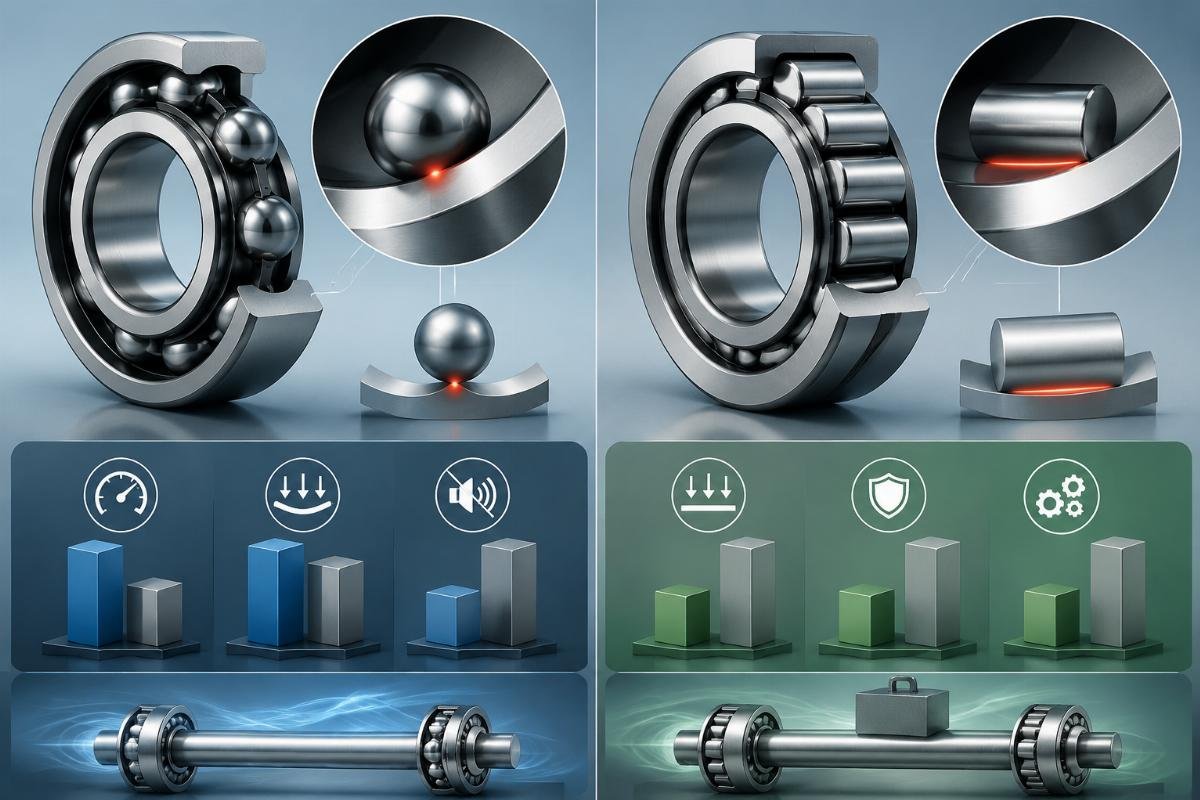
- Load Direction Analysis – Determine if loads are primarily radial, axial, or combined, as this dictates whether ball (better for combined loads) or roller (better for pure radial loads) bearings are appropriate.
- Speed Calculation – Compare operating RPM against bearing manufacturer speed limits, factoring in lubrication type and temperature constraints.
- Precision Requirement – Specify accuracy grade (P2-P5 for ball bearings, P5-P6 for rollers) based on application tolerances and vibration sensitivity.
- Environmental Assessment – Evaluate contamination risks, temperature extremes, and moisture levels to select appropriate sealing and material options.
- Failure Mode Review – Analyze historical failure data to identify patterns that might indicate mismatch between current bearing type and application needs.
How to Select the Right Bearing Type for Your Specific Industrial Application?
The decision tree must prioritize application conditions over general load assumptions. While roller bearings excel in heavy radial load scenarios like conveyor systems, ball bearings often outperform in applications involving high speeds, precision requirements, or combined load directions—making proper selection critical to avoiding costly downtime.
| Selection Factor | Common Mistake | Engineering Best Practice |
|---|---|---|
| Load Assessment | Focusing solely on load magnitude | Analyzing load direction, variability, and shock characteristics |
| Speed Consideration | Using nominal speed ratings without correction factors | Applying bearing manufacturer speed factors for lubrication and temperature |
| Misalignment Tolerance | Assuming all bearings accommodate misalignment equally | Selecting self-aligning roller bearings for shaft misalignment exceeding 0.5° |
| Cost Evaluation | Prioritizing upfront cost over total lifecycle cost | Calculating TCO including installation, maintenance, and downtime costs |
| Material Selection | Defaulting to standard steel for all applications | Specifying ceramic hybrid or stainless steel options for corrosive or high-temperature environments |
When a mining operation faced $20,000 per hour in downtime due to failed spherical roller bearings in their conveyor system, our team implemented an emergency response protocol that combined rapid delivery with engineering analysis. The 22315 spherical roller bearings (10 pieces) were delivered within 48 hours through our self-operated warehousing network, but we also discovered that the root cause wasn’t the bearing quality—it was an incorrect lubrication interval. By adjusting the relubrication schedule and implementing condition monitoring, we helped the client reduce bearing replacement frequency by 35% over the next 12 months. This case highlights why technical support should accompany even emergency supply scenarios—addressing symptoms without root cause analysis leads to recurring issues.
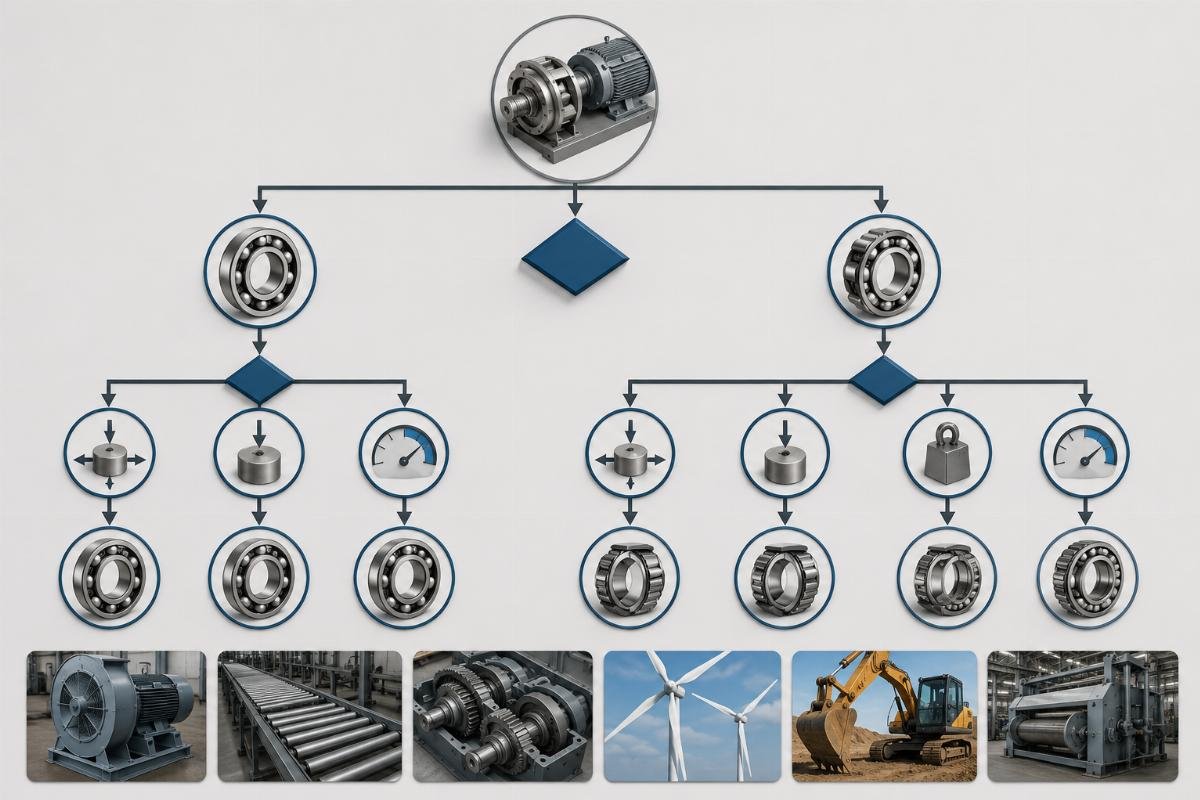
- Conduct Load Analysis – Measure radial and axial load magnitudes, including peak loads and shock factors, using manufacturer-recommended calculation methods.
- Determine Speed Requirements – Calculate actual operating RPM and apply correction factors for lubrication type, temperature, and bearing arrangement.
- Evaluate Misalignment – Measure shaft misalignment under operating conditions and select bearings with appropriate self-aligning capabilities if needed.
- Assess Environmental Conditions – Identify temperature ranges, contamination risks, and exposure to moisture or chemicals to specify appropriate materials and seals.
- Calculate Service Life – Use ISO 281 or manufacturer-specific formulas to estimate L10 life and compare against maintenance intervals.
What Advantages Do China Bearing Suppliers Offer for Industrial Procurement?
Supplier selection is as critical as bearing type selection. When evaluating China suppliers, the key differentiators are not price alone but the combination of authentic product sourcing, technical support capabilities, and logistics infrastructure that ensures consistent performance and minimized downtime.
| Supplier Capability | Standard Offerings | Premium China Supplier Advantages |
|---|---|---|
| Product Authenticity | Basic certification | Full traceability documentation with material test reports and certificate of origin |
| Inventory Management | Limited stock availability | 10,000+ SKUs covering major brands (SKF, FAG, NSK) with 72-hour dispatch for standard models |
| Technical Support | Basic cross-referencing | Application engineering, load calculation, and failure analysis with written reports |
| Logistics Network | Standard shipping options | Global self-operated warehousing with emergency air freight capabilities for critical downtime scenarios |
| Quality Assurance | Visual inspection only | Dimensional measurement, material certification verification, and anti-counterfeiting checks |
A wind energy OEM approached us needing custom hybrid ceramic bearings for their gearbox application, requiring precision grade P5 and specific material certifications (Si3N4 ceramic balls with AISI 440C races). Our 3-month sample qualification cycle included not just product supply but comprehensive testing support, including协助 with ISO 15243 vibration testing and material composition analysis. The 500-piece initial order was delivered with full documentation packages, enabling the client to meet their certification deadlines while achieving a 17% cost reduction compared to their previous European supplier. This case demonstrates how China suppliers with engineering capabilities can deliver both cost advantages and technical compliance for demanding OEM applications. [NEED_CITE: ISO 15243 specifies vibration measurement methods for rolling bearings]
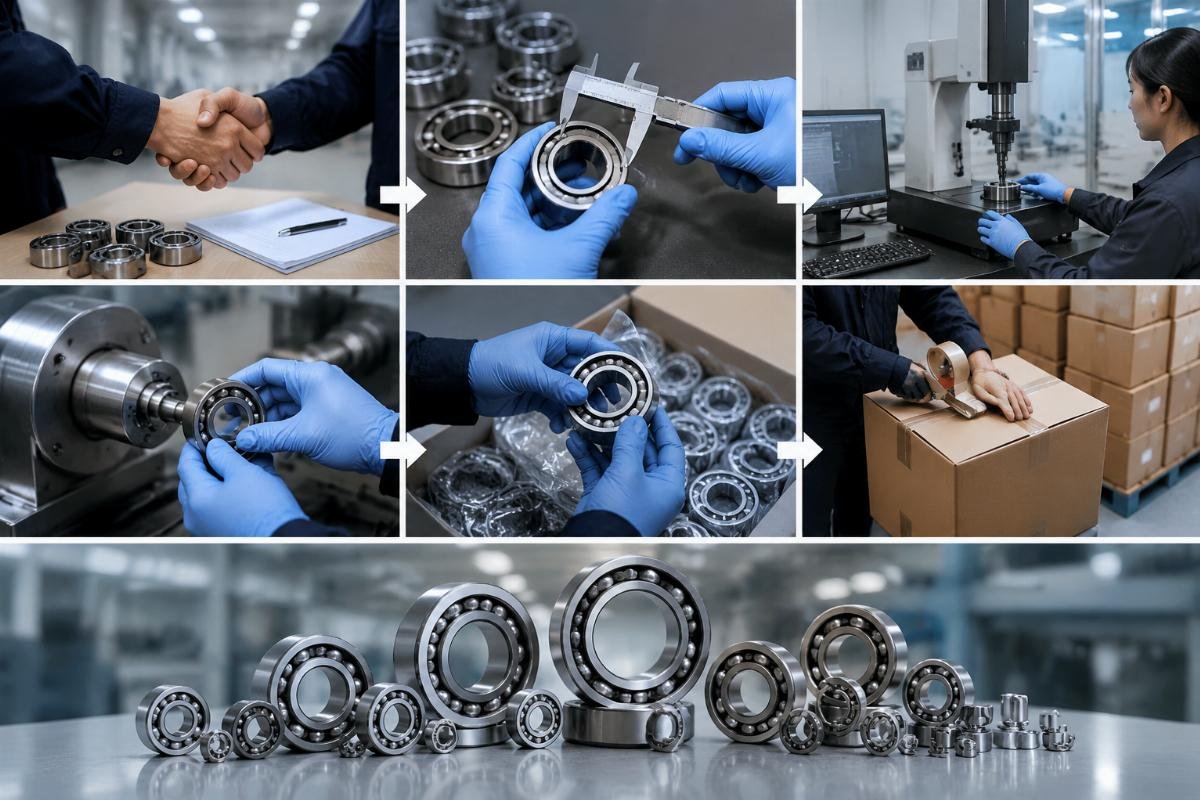
- Request Traceability Documentation – Ask for material test reports, manufacturing origin certificates, and batch traceability records for all critical bearings.
- **Verify

Leave a Reply