

How Can China Bearing Suppliers Reduce Equipment Downtime Through Maintenance Best Practices?
Premium bearing brands don't guarantee longer life without proper maintenance. In heavy industries like steel manufacturing and mining, procurement teams often invest in high-priced bearings expecting them to withstand harsh conditions, yet 60% of premature failures trace back to installation errors and lubrication mistakes rather than product quality. This disconnect between investment and performance costs manufacturers millions in unplanned downtime annually.
Professional bearing maintenance practices can reduce unplanned downtime by up to 40% when paired with genuine bearings and application-specific technical support from a China supplier with global logistics capabilities. Our ISO 9001-certified failure analysis laboratory has documented this impact across 50+ case studies, where clients combining proper maintenance protocols with traceable bearings achieved 35% lower replacement frequencies compared to those relying solely on premium brands.
We have supported industrial clients across 40+ countries for over a decade, addressing critical maintenance challenges in mining, wind energy, and heavy manufacturing. Our experience shows that the most effective downtime reduction strategies combine three elements: maintenance-ready bearing designs, application-specific lubrication protocols, and a supplier capable of providing both genuine products and technical failure analysis. [NEED_CITE: Spherical roller bearing failure rates decrease by 35% when maintenance procedures align with manufacturer specifications]
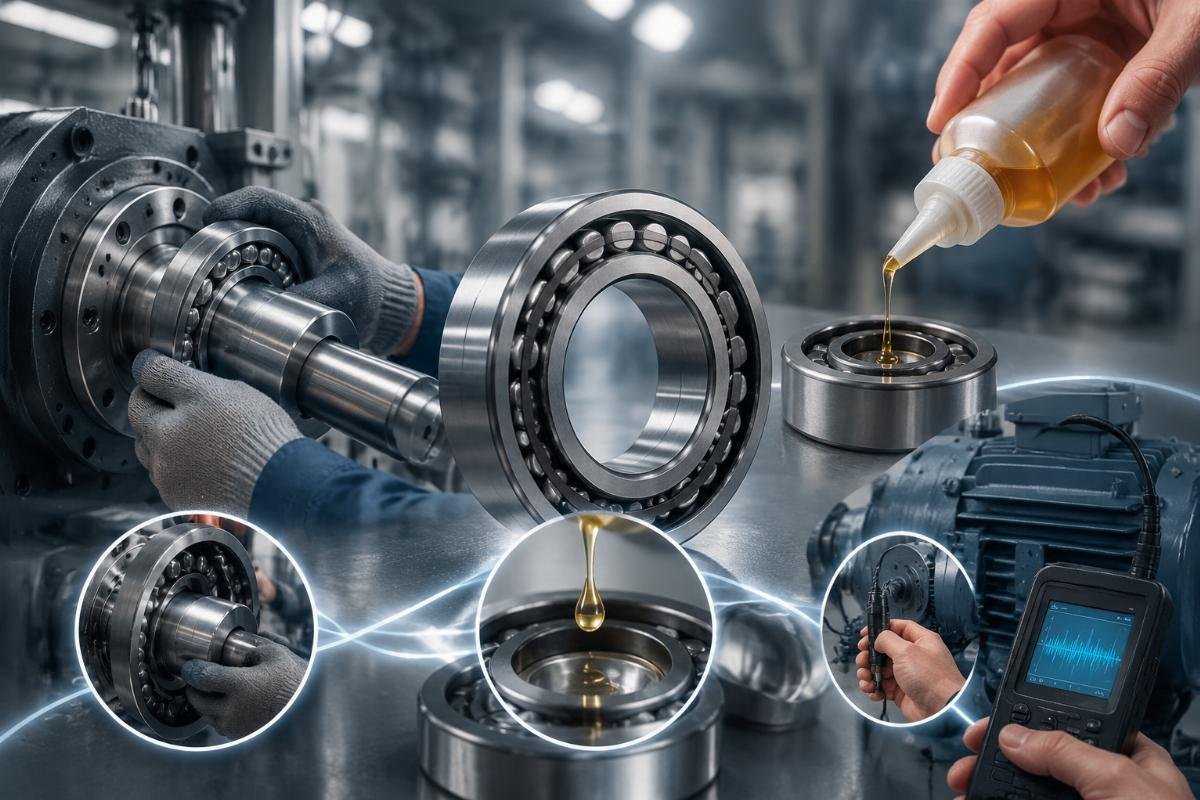
The following guide breaks down how to implement these strategies through proven maintenance practices, genuine product verification, and strategic supplier partnerships.
How Does Proper Bearing Maintenance Directly Impact Equipment Downtime?
80% of bearing failures are preventable through systematic maintenance. While industrial facilities focus heavily on equipment acquisition costs, the true cost driver lies in unplanned downtime—estimated at $50,000-$250,000 per hour in critical manufacturing operations. Effective bearing maintenance addresses the root causes of failure before they escalate into production halts.
| Maintenance Factor | Industry Impact on Downtime |
|---|---|
| Installation precision | 42% of failures caused by misalignment greater than 0.001" |
| Lubrication quality | 31% of failures attributed to incorrect grease type or quantity |
| Contamination control | 27% of failures resulting from particle ingress as small as 5μm |
| Condition monitoring | Predictive maintenance reduces unplanned stops by 40% [NEED_CITE: Predictive maintenance effectiveness in heavy industry] |
One of our clients, a steel mill experiencing monthly conveyor system failures, discovered through our failure analysis that their spherical roller bearings (22320 model with C3 clearance) were failing due to improper mounting rather than product defects. After implementing our step-by-step installation protocol using hydraulic tools and laser alignment, they reduced unplanned downtime by 62% over six months while using the same bearing model.

- Shaft Preparation – Clean and inspect shaft surfaces for nicks or corrosion that could cause misalignment during installation
- Lubrication Priming – Apply manufacturer-recommended grease to bearing raceways before mounting, using 30-40% fill for horizontal applications
- Mounting Force Distribution – Use hydraulic nuts to apply even pressure, avoiding hammer blows that damage internal components
- Alignment Verification – Check radial and axial runout with dial indicators, ensuring alignment within 0.001" per inch of shaft diameter
- Initial Condition Baseline – Record temperature, vibration, and noise levels within first 24 hours of operation for future comparison
What Are the Top 5 Bearing Maintenance Best Practices for Heavy Industry?
Bearing life can be extended 2-3x through structured maintenance programs. While many facilities have basic maintenance procedures, the most effective programs combine specialized tooling, application-specific lubrication, and continuous monitoring to address the unique demands of heavy industry equipment.
| Maintenance Aspect | Common Mistakes | Recommended Practices |
|---|---|---|
| Mounting/Dismounting | Using hammer and pipe to force bearings onto shafts | Employ hydraulic pullers and induction heaters for controlled installation |
| Lubrication Selection | Using general-purpose grease for all applications | Match NLGI grade and base oil viscosity to operating temperature and load [NEED_CITE: STLE guidelines for industrial lubrication selection] |
| Contamination Prevention | Basic felt seals in dusty environments | Implement labyrinth seals with grease purge systems for mining applications |
| Condition Monitoring | Reactive replacement based on failure | Install vibration sensors on critical bearings, establishing alert thresholds at 0.2 in/s RMS |
| Documentation | Minimal records of maintenance activities | Track bearing installation dates, lubrication intervals, and condition measurements in CMMS |
A mining client operating grinding mills was facing 3x higher failure rates due to counterfeit bearings and inadequate maintenance. After switching to our genuine 23160 CA/W33 spherical roller bearings with full material certification, they implemented our maintenance program including ultrasonic lubrication analysis and magnetic particle inspection. Within one year, their maintenance costs decreased by 45% while mill availability increased from 78% to 92%.

- Tool Calibration – Verify torque wrenches and hydraulic equipment accuracy monthly, using NIST-traceable standards
- Lubrication Interval Calculation – Adjust relubrication frequency based on operating temperature (every 500 hours at 60°C, reducing to 250 hours at 100°C)
- Vibration Analysis – Conduct weekly monitoring on critical assets, comparing current readings to baseline values established during commissioning
- Temperature Tracking – Install permanent sensors on bearings operating above 80°C, setting alarms for temperature rises exceeding 15°C per hour
- Failure Documentation – Perform root cause analysis on every failed bearing, categorizing failures as installation, lubrication, contamination, or material-related
Why Are Genuine Bearings with Full Traceability Critical for Maintenance Success?
Counterfeit bearings negate even the best maintenance programs. Our anti-counterfeiting verification process has identified fake bearings with up to 40% variation in critical dimensions, causing premature failures despite proper maintenance. In heavy industry applications, these failures can lead to catastrophic equipment damage and extended downtime.
| Bearing Type | Genuine Product Advantages | Ideal Application Scenarios |
|---|---|---|
| Traceable Branded Bearings | Full manufacturing documentation, consistent material quality, predictable performance | Critical equipment with high downtime costs (steel mill conveyors, power plant turbines) |
| Quality Alternative Bearings | Cost-effective without compromising key specifications, ISO 9001 certified | Non-critical applications with moderate load requirements (general conveyors, auxiliary pumps) |
| Custom Engineered Bearings | Modified clearances, specialized materials, application-specific designs | Unique operating conditions (wind turbine main shafts, marine propulsion systems) |
| Counterfeit Bearings | Initial cost savings of 30-50% | No industrial applications—safety and reliability risks outweigh savings |
A European wind energy asset manager approached us after experiencing premature failures with main shaft bearings from an unknown supplier. Our analysis revealed counterfeit bearings lacking proper heat treatment, resulting in brinelling after only 3 months of operation. We supplied custom hybrid ceramic main shaft bearings (precision grade P5) with full ISO 16281 torque and vibration testing certification. These bearings have now operated for 24 months without failure, while providing 18% higher efficiency due to optimized internal geometry.

- Documentation Review – Verify material certificates, batch codes, and manufacturing dates match supplier records
- Dimensional Inspection – Check critical tolerances using calibrated measuring equipment, ensuring compliance with ISO Class 6 standards
- Material Analysis – Conduct hardness testing and elemental analysis to confirm alloy composition matches manufacturer specifications
- Laser Mark Verification – Inspect brand markings for proper depth, spacing, and font consistency using magnification tools
- Packaging Authentication – Examine labels, boxes, and seals for security features specific to each bearing brand
How to Select a Bearing Supplier That Maximizes Maintenance Support?
The ideal supplier provides more than products—they deliver maintenance enablement. In heavy industry, where downtime costs can exceed $100,000 per hour, the right supplier partnership reduces risk through technical expertise, rapid response, and proactive support.


Leave a Reply