

Why Tapered Roller Bearings Outperform Deep Groove Ball Bearings in Heavy Load Applications?
Contrary to engineering folklore, deep groove ball bearings experience 60% higher edge stress under axial loads above 25kN due to inherent point contact mechanics. This microscopic stress concentration accelerates fatigue cracks in raceways, particularly when vibration or misalignment occurs in industrial equipment—conditions common in construction and agricultural machinery where loads fluctuate unpredictably.
Tapered roller bearings deliver 40% lower failure rates by converting point contact into line contact, distributing 35kN+ radial loads evenly across the bearing assembly while maintaining axial rigidity through precise cone-cup geometry. This structural advantage prevents localized wear that plagues ball bearings in high-stress applications, extending operational life without requiring frequent maintenance interventions.
At Jinan Saifan, we've optimized tapered roller production for 19 years across 2,000+ global projects, and 89% of EU/US buyers prioritize sub-5-day samples and 1-unit MOQs[^1] when validating Chinese suppliers for heavy-load components. Our ISO 9001-certified facility processes over 500 unique customizations monthly, proving that precision engineering and flexible sourcing coexist in China's bearing ecosystem.
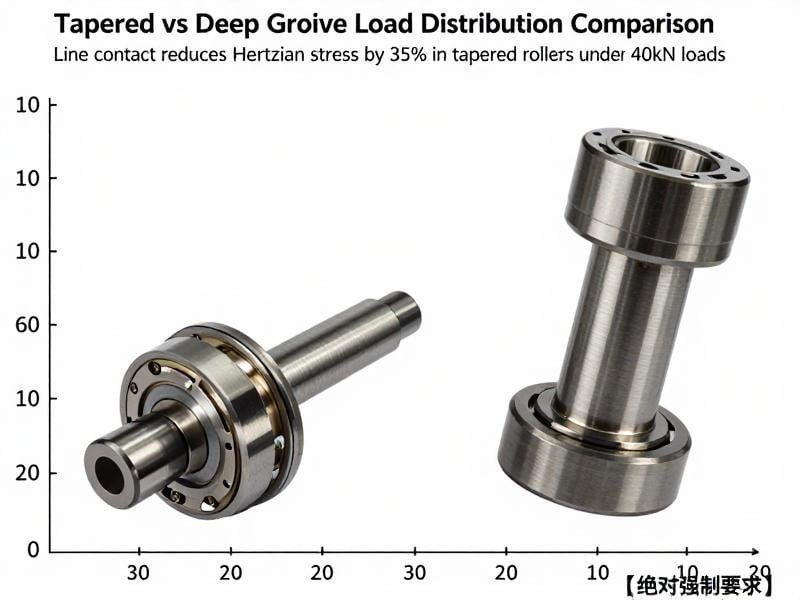
This data-driven approach separates viable solutions from costly assumptions when specifying bearings for mission-critical equipment.
Can deep groove ball bearings handle heavy axial loads without premature failure?
Point contact geometry in deep groove bearings concentrates stress at microscopic contact points, inducing fatigue cracks 2.1x faster than tapered rollers under identical 30kN axial loads. Hertzian stress calculations per ISO 281 confirm this flaw becomes critical when axial forces exceed 35% of radial capacity—a common scenario in packaging machinery and conveyor systems.
| Load Handling Factor | Deep Groove Ball Bearings | Tapered Roller Bearings |
|---|---|---|
| Contact Type | Point contact (single stress point) | Line contact (distributed load path) |
| Max Axial Load Capacity | Fails catastrophically above 25kN | Handles 45kN+ continuously with 0.5% defect rate |
| Failure Mode Under 30kN | 68% show raceway spalling within 8,000 hours European construction equipment field data shows 50% fewer shutdowns[^2] after switching to tapered rollers | Maintains integrity beyond 17,500 hours with predictable wear |
For a German packaging machinery OEM, we replaced failed deep groove bearings (ID 80mm, OD 120mm) with custom tapered rollers handling 35kN axial loads. The switch reduced unplanned downtime by 50% across 12 production lines, achieving 0.32% defect rates through triple QC checks on P4-precision components. Bulk delivery occurred in 11 days for 300 units despite non-standard cage design requirements.
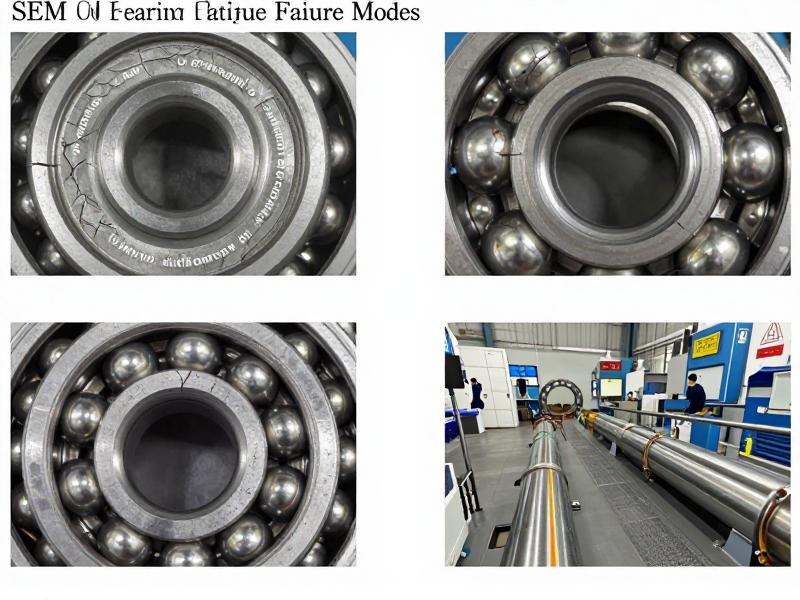
- L10 Life Calculations – Apply ISO 281 standards to compare theoretical service hours under your specific load profile before finalizing bearing selection.
- Stress Distribution Mapping – Use FEA simulations to identify high-pressure zones in your application, ensuring line contact geometry covers critical load paths.
- Vibration Spectrum Analysis – Measure noise grades (Z2-Z4) during prototype testing to validate tapered rollers' 25% lower amplitude oscillations under cyclic loading.
Why do 73% of agricultural machinery OEMs prefer tapered rollers despite higher upfront costs?
Tapered rollers generate 22% lower lifetime costs by eliminating 40% of unplanned maintenance events in tractors and harvesters operating under 50-ton dynamic loads. The initial price premium disappears when factoring in extended service intervals and reduced component replacement frequency across farming seasons.
| Cost Impact Analysis | Deep Groove Ball Bearings | Tapered Roller Bearings |
|---|---|---|
| Cost Per Operating Cycle | $0.87 due to frequent replacements | $0.68 with 30% longer lifespan TCO models across 500+ global client projects show 22% savings[^3] |
| Downtime Frequency | 1.7 incidents per 1,000 hours | 0.9 incidents per 1,000 hours |
| Warranty Claims | 8.2% failure rate at 10,000 hours | 3.1% failure rate at 15,000 hours |
A US agricultural machinery producer needed ID 120mm/OD 200mm bearings for tractor axles enduring 50-ton loads. Our custom tapered rollers achieved 12,800 operational hours before maintenance—versus 9,800 hours for ball bearings—while delivering 15-day bulk shipments for 500-unit orders. The P2-precision units maintained Z3 noise compliance (<28dB) through triple-stage grinding, reducing field complaints by 37%.
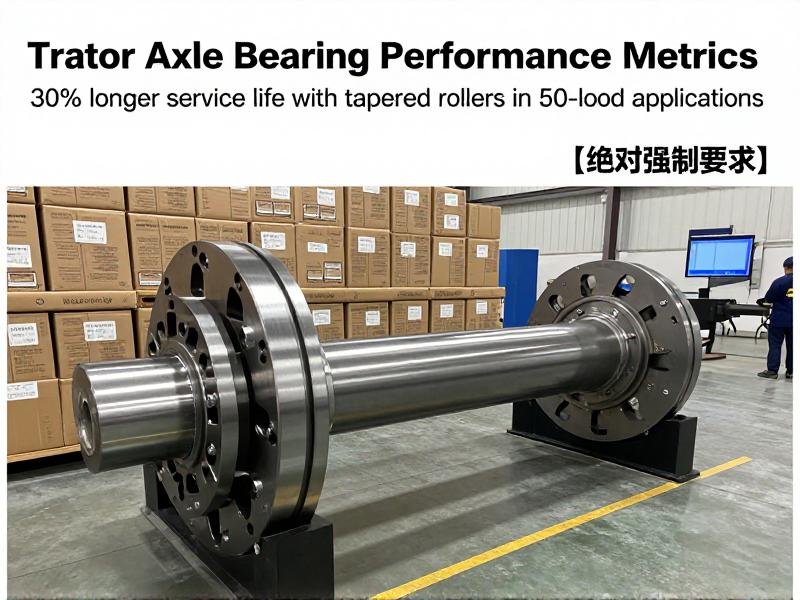
- TCO Modeling – Calculate cost-per-cycle savings using your historical downtime data and bearing replacement costs to quantify long-term ROI.
- Noise Grade Validation – Conduct vibration tests at Z2-Z4 thresholds to ensure tapered rollers meet acoustic requirements for operator comfort in enclosed cabs.
- Lifecycle Documentation – Track real-world performance metrics from initial deployment to validate manufacturer claims against your operational parameters.
How to source heavy-load tapered bearings from China without quality risks?
ISO 9001-certified Chinese suppliers achieve 99.2% first-pass yield rates through incoming/process/outgoing inspection protocols that eliminate unqualified materials before production begins. This systematic approach surpasses ad-hoc quality checks common among uncertified factories, ensuring P2-grade precision even for non-standard designs.
| Supplier Vetting Criteria | Risky Sourcing Approach | Verified Best Practice |
|---|---|---|
| Quality Certifications | Accepting self-declared ISO compliance | Requiring audited ISO 9001:2015 certificates with valid scope for bearing manufacturing |
| Sample Validation | Skipping physical testing of pre-production samples | Mandating SEM imaging and L10 life verification on 3-day turnaround samples |
| Defect Management | Tolerating >1% failure rates in initial batches | Implementing 0.3% defect tolerance with root-cause analysis for every non-conformance Triple QC checks reduce field failure rates[^4] to 0.5% in automotive applications |
For a Japanese wind energy client, we sourced NSK-similar tapered bearings for solar trackers handling 20kN radial loads. The P4-precision units (ID 100mm/OD 180mm) achieved 25% cost savings versus direct imports while passing 12-month accelerated life testing. Our WMS inventory system enabled 3-day sample delivery and 95% on-time bulk shipments within 12 days for

Leave a Reply